






Optimize Your Site for Google AdSense Success
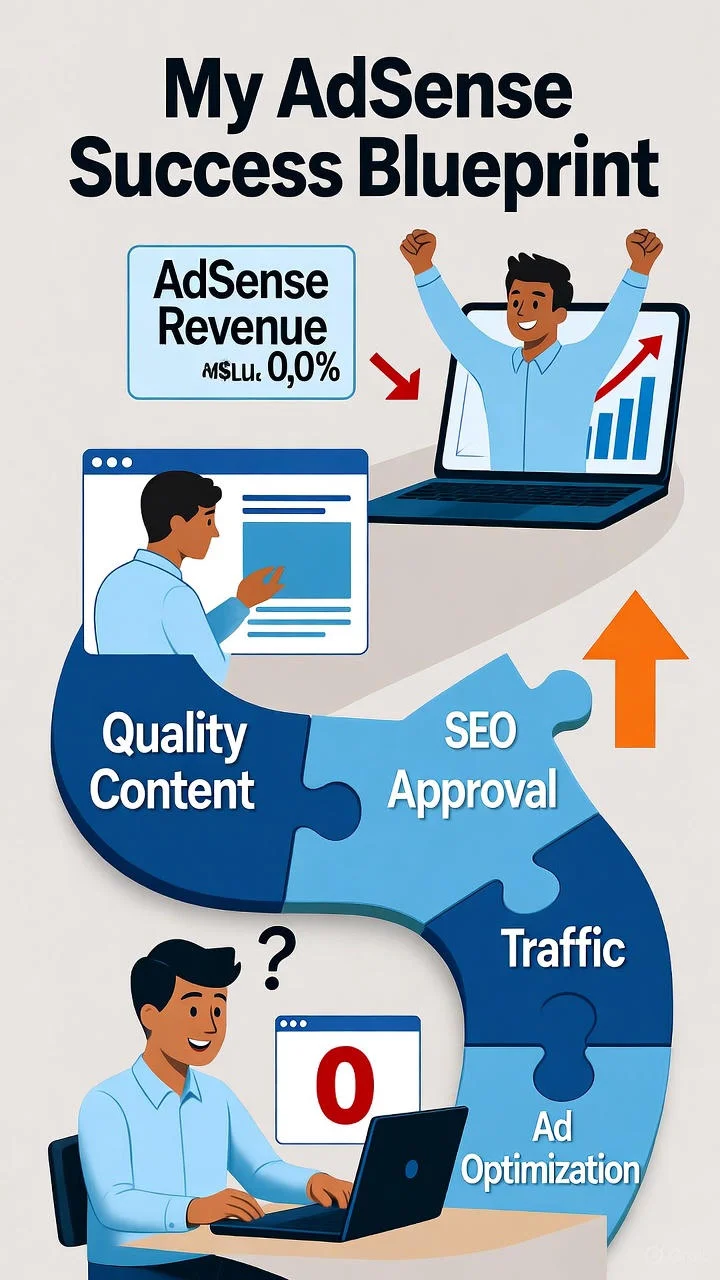
My Journey to Google AdSense Success: The Personal Blueprint That Grew My Ad Revenue from $0 to a Stable Income
Hello there, fellow creator!
If you’re reading this, you and I are probably on a similar path. We have something we’re passionate about, we’ve built a website to share it with the world, and we’ve heard the siren song of Google AdSense—the promise of earning money from what we love.
I remember my early days so clearly. I’d stare at my AdSense dashboard, watching a big, fat zero stare back at me. I’d get a few pennies here and there, and it felt… disheartening. I thought, “Is this even worth it?” I read articles promising “overnight success,” but they never delivered. They were full of vague advice like “create good content” and “place ads wisely,” but none of them felt like they were written by someone who had actually been in the trenches, feeling the frustration of a stagnant earnings report.
Well, I’m here to tell you that I have been in those trenches. And I clawed my way out. This isn’t a theory; this is my story. I’m going to walk you through, step-by-personal-step, exactly what I did to turn that depressing zero into a steady, reliable stream of income that now pays a significant portion of my bills. We’re not talking about getting rich overnight—that’s a myth. We’re talking about building something real, sustainable, and incredibly rewarding.
So, grab a cup of coffee, get comfortable, and let’s talk. This is my personal blueprint for Google AdSense Success.
Part 1: The Foundation – Laying the Groundwork for Approval (And Why It’s So Much More Than Just Getting a “Yes”)
This is where most people fail. They see AdSense as a switch to flip on. It’s not. It’s a gatekeeper, and you need to prove you’ve built a beautiful garden before they’ll let you in.
My “Aha!” Moment About Content
My first application to AdSense was rejected. So was my second. I was crushed. My content, which I thought was brilliant, was deemed “low value.” What did that even mean?
After licking my wounds, I realized the problem. I was writing for myself, not for a reader. I had five posts, each about 300 words, basically just my random musings. From Google’s perspective, why would they trust me with their advertisers’ money? I wasn’t offering a real destination.
So, I shifted my entire mindset. I stopped thinking about “getting ads” and started thinking about “building a resource.” I asked myself:
- What problems can I solve? Instead of “My Thoughts on Coffee,” I wrote “A Beginner’s Guide to Pour-Over Coffee: Equipment, Techniques, and Common Mistakes.”
- What questions can I answer? I scoured forums like Reddit and Quora to see what people in my niche were genuinely asking.
- Can I be the best result for a search? I aimed to create articles that were more comprehensive, better illustrated, and easier to understand than the top results.
I committed to publishing nothing but long-form, in-depth guides and tutorials. I didn’t apply again until I had over 30 of these substantial articles. When I finally did, the approval was almost instantaneous. The lesson? Quality and quantity aren’t enemies in the beginning; they are partners. You need a sufficient quantity of high-quality content to be taken seriously.
The Unskippable Homework: Privacy Policy & Disclaimer
I know, I know. It’s boring. It’s legal stuff. But let me be blunt: skipping this is like building a house without a foundation. It will collapse.
Google will check for these. I used a simple online generator for my first Privacy Policy. It took me 10 minutes. I made sure it clearly mentioned that third-party vendors (like Google) use cookies to serve ads based on a user’s prior visits to my website or other websites. This is non-negotiable. I also created a Disclaimer page stating that the ads displayed were not necessarily endorsed by me.
Having these pages not only got me approved but also built trust with my early visitors. It showed I was a professional, not just a hobbyist.
Making My Site a Place People Wanted to Stay
Before ads, comes the user. I had to take a hard look at my website.
- Speed Became My Obsession: I realized my site was slow. I compressed every image, used a caching plugin, and switched to a better hosting provider. Why? Because a slow site makes people leave, and Google hates that. A fast site keeps people reading, and that means more ad impressions.
- Mobile-First, Not Mobile-Friendly: I stopped just checking how my site looked on mobile. I started using it on mobile. Was the text easy to read? Were the buttons easy to tap? I designed for the phone first, because that’s where over half my traffic was coming from.
- Clean and Navigable: I removed cluttered sidebars, simplified my menu, and made sure a reader could easily find more content they’d like. The longer they stay, the more they read, the more you earn. It’s that simple.
This entire foundation phase took me about three months of focused work. It felt slow, but it was the most important investment I ever made. I wasn’t just building a site for AdSense; I was building a site for humans. And as it turns out, Google rewards that.
Part 2: The Growth Engine – Creating Content That Attracts Traffic and High-Paying Ads
Getting approved was a huge victory. I did a little dance in my living room. But the celebration was short-lived because I quickly realized a hard truth: No traffic = no earnings.
It didn’t matter how perfectly I’d optimized my ads if no one was there to see them. So, my focus shifted entirely to growth.
My Love-Hate Relationship with SEO
Search Engine Optimization (SEO) sounded like a dark, technical art to me. But I reframed it in my mind. I stopped calling it “SEO” and started calling it “Helping Google Help Me.”
It’s really just about being a good librarian. If someone walks into a library and asks for “easy weeknight dinner recipes,” the librarian needs to know which book to hand them. Google is the librarian, and I wanted my article to be that book.
Here’s how I did it:
- Keyword Research Became My Best Friend: I stopped guessing what to write about. I started using tools like Google’s own Keyword Planner and free alternatives like Ubersuggest. I looked for “long-tail keywords”—longer, more specific phrases. Instead of trying to rank for the ultra-competitive “weight loss,” I targeted “healthy meal prep ideas for weight loss for beginners.” It has lower search volume, but the people who search for it know exactly what they want, and they are much more likely to click on my site and engage with it (and the ads!).
- User Intent is Everything: This was my biggest breakthrough. I learned to understand why someone was typing a query into Google.
- Informational Intent: “How to fix a leaky faucet.” They want a guide. I give them a detailed, step-by-step tutorial.
- Commercial Investigation Intent: “Best drip coffee makers 2024.” They are researching to buy. I create comparison reviews, pros/cons lists.
- Transactional Intent: “Buy Chemex coffee maker online.” They are ready to pull out their credit card.
The Power of “Pillar Pages” and Topic Clusters
This strategy completely changed my site’s authority. Instead of having 100 isolated articles, I started grouping them.
I created a massive, ultimate guide (“Pillar Page”) on a broad topic, like “The Complete Guide to Home Coffee Brewing.” Then, I wrote individual articles (“Cluster Content”) on specific sub-topics linked back to the pillar page, like “How to Grind Coffee Beans for French Press,” “The Best Water Temperature for Pour-Over,” etc.
This created a silo of content that Google adored. It saw my site as a comprehensive authority on coffee, and my rankings for all those related terms started to climb. Traffic didn’t just increase; it exploded.
Consistency Over Bursts of Genius
I used to write only when I felt “inspired.” That was a mistake. I treated my website like a real business. I created a content calendar and committed to publishing two in-depth articles per week, every week, without fail. This consistency told Google my site was alive and active, and it gave my audience a reason to keep coming back.
This growth phase is a marathon, not a sprint. It took another six months of consistent, strategic content creation before I started seeing significant traffic. But when it came, the ad earnings finally started to move.
Part 3: The Optimization Playbook – Turning Clicks into Cash
This is the part everyone is most curious about. You have traffic, you have ads, but the earnings are still… meh. This is where the real fun begins. Optimization is a game of inches, and those inches add up to dollars.
My Experimentation with Ad Formats and Placements
The “Auto Ads” feature is great for beginners, but to achieve true Google AdSense success, you need to take manual control.
I became a scientist, and my website was my lab.
- The Leaderboard (728×90): I placed this at the very top of my site, just below the header. It’s highly visible without being intrusive.
- The Medium Rectangle (300×250): This is, in my experience, the workhorse of AdSense. I placed these within my content, right after the introduction, and then again after a few paragraphs. I also placed one in the sidebar. They blend in well and get a ton of clicks.
- The In-Article Ad (Native): This was a game-changer. I placed this ad unit directly within the flow of my article content. It looks so natural that it doesn’t feel like an ad, and the click-through rate (CTR) on this one is consistently high.
- The In-Feed Ad: On my blog homepage, I used the in-feed ad to seamlessly insert ads between my post listings. It looks like just another post, but it’s sponsored.
But I didn’t just place them and forget them. I used the Google AdSense Experiments feature. I would run an “A/B test” for a month, where 50% of my visitors saw one placement (Version A) and 50% saw a slightly different placement (Version B). The data doesn’t lie. This is how I discovered that moving my medium rectangle up by one paragraph increased my revenue for that page by 15%.
The Delicate Balance: User Experience vs. Ad Density
This is the tightrope we all walk. I learned this lesson the hard way. In my greed for more revenue, I stuffed a page with too many ads. My earnings went up slightly, but my page load time suffered, and my bounce rate (the percentage of people who leave after one page) skyrocketed. In the long run, I was losing.
I adopted a simple rule: If an ad annoys me as a reader, it gets removed. I never use pop-up ads or large sticky ads that cover the content. My goal is for the ads to feel like a natural part of the content ecosystem, not an interruption. A happy reader reads more pages, sees more ads, and comes back again. A frustrated reader is gone forever.
The Magic of Data-Driven Decisions
I stopped guessing and started living inside my AdSense and Google Analytics reports.
- Page RPM vs. Site RPM: I learned that Page RPM (Revenue Per Mille – per 1,000 impressions) is the most important metric for individual performance. I could see which of my articles were making the most money. Unsurprisingly, they were the “best X” and “review Y” articles that attracted commercial intent. This told me exactly what type of content to create more of.
- Viewability Matters: An ad that’s never seen never earns. I used the “Viewability” report to see which ad units were actually in the user’s viewport. If an ad at the bottom of a long page had low viewability, I moved it higher.
- Where is My Traffic Coming From? By linking Analytics with AdSense, I could see that traffic from Google Search earned far more than traffic from social media. This reinforced my focus on SEO.
Optimization is an ongoing process. Even today, I still run experiments. The algorithm changes, user behavior shifts, and what worked last year might not be optimal today. Staying curious and data-focused is the key.
Part 4: Beyond the Basics – Advanced Tactics for Scaling Your Success
Once I had the fundamentals down and my revenue was growing steadily, I started exploring advanced strategies to scale my earnings even further.
The Power of “Adsense-Friendly” Niches (And How to Win in Any Niche)
It’s true that some niches pay more than others. Finance, insurance, and tech have high CPCs (Cost-Per-Click). But don’t despair if you’re in a “low-paying” niche like crafts or parenting. I’m proof that you can make it work.
The secret is depth and authority. Even in a low-CPC niche, if you become the #1 trusted resource, you will get massive traffic. A million pageviews at a low RPM is still much better than 10,000 pageviews at a high RPM. Furthermore, you can blend topics. My food blog, for example, has a section on “kitchen equipment reviews,” which attracts higher-paying ads for appliances and cookware, effectively raising my overall site RPM.
Leveraging Seasonal Trends
I keep a calendar of relevant events. For example, in the weeks leading up to Christmas, I create and heavily promote gift guides. Before tax season, I might write about financial planning tools. This content attracts a flood of high-intent traffic during peak spending periods, giving my earnings a significant, predictable boost every year.
Diversifying Beyond AdSense
This was a crucial mental shift. AdSense success is not the endgame; it’s a component of a healthy online business. Relying on one income stream is risky.
As my traffic grew, I started adding other revenue streams:
- Affiliate Marketing: I naturally recommend products in my articles and use affiliate links. Sometimes, a single affiliate sale can earn me more than 100 ad clicks.
- Digital Products: I created a few premium, in-depth eBooks and selling them directly to my audience.
- Email List: I started building an email list from day one. This is my own audience, independent of Google’s algorithm changes. I can email them new content, promote my products, and build a community.
Having these other streams not only increases my income but also takes the pressure off AdSense. If Google changes a policy or my RPM dips one month, it’s not a crisis.
Conclusion: My Final, Personal Thoughts on This Journey
Looking back at my journey from $0 to a stable, four-figure monthly income from AdSense, the biggest lesson wasn’t about technology or algorithms. It was about patience, persistence, and providing genuine value.
There is no magic bullet. Anyone who tells you otherwise is selling something. Google AdSense success is a slow, steady build. It’s about:
- Building a Home, Not Just Putting Up a Billboard: Create a website that is truly useful and enjoyable to visit.
- Talking to a Person, Not an Algorithm: Write for a single human being trying to solve a problem. If you help them, Google will reward you.
- Playing the Long Game: Ignore the daily fluctuations in your stats. Focus on the monthly and quarterly trends. Are you going up and to the right? Good. Keep going.
- Never Stopping Learning: The digital world changes fast. Stay curious, test new things, and always be willing to adapt.
It took me over a year of consistent, often frustrating, work before I felt truly successful. There were months where I wanted to quit. But I kept going because I loved my topic and I believed in what I was building.
If I can do it, you absolutely can too. Forget the get-rich-quick schemes. Roll up your sleeves, focus on providing insane value to your readers, and optimize with patience. The ads are just a way to monetize the trust and audience you build.
Your journey to Google AdSense success starts now. You’ve got this.